Published
(1 Sep 2015) LEAD-IN:
France is becoming a leader in the production of caviar as demand for the expensive delicacy continues to rise.
Three companies are now running aquaculture projects, turning out high quality fish eggs from Siberian sturgeons, grown in a controlled environment.
STORY-LINE :
It's often referred to as black gold - rare, exclusive and expensive.
Caviar is mostly known as a product from the Caspian Sea - with the most coveted eggs from the wild Beluga sturgeon, followed by Sevruga and Sterlet.
Traditionally, the main producers of caviar are from countries bordering the Caspian - Russia, Iran, Kazakhstan, Azerbaijan and Turkmenistan.
But as they grapple with problems linked to overfishing, other countries are now producing their own high quality products thanks to advances in aquaculture.
L'Esturgeonniere is one of three companies in the Aquitaine region in south western France that produces caviar.
It is one of the leaders of producing caviar in an aquaculture environment, using Siberian sturgeon, according to farm manager, Michel Berthommier
"The specificity of the French production (of caviar) is that it is about fish that was farmed since more than 30 years and that we were the first ones in France to make caviar of Siberian Sturgeon. That know how is historic and now, France is the country with the biggest history of caviar production in aquaculture," he says.
L'Esturgeonniere takes the water for its pools from the local river. The water is then heated to encourage spawning.
A lot of the knowledge the farmers gained was learnt on the job through trial and error.
"There was no school, we learned on the job. When I arrived here this was a farm that was producing only the sturgeon (not caviar); we had a problem with the market study regarding the price of the fish, so we said 'Sturgeon makes eggs, makes caviar, so let's make caviar.' So we were trying, tasting, we were testing until we defined our salting and our caviar," says caviar production manager, Marion Bouscaut.
Bouscaut says tests and improvements are made on a regular basis, especially getting the right flavour.
She says the right mix of salt with the roe is crucial as it can be the deciding factor between a good and bad caviar.
L'Esturgeonniere says it's found a way to turn its farmed Siberian sturgeon into a flavour that just about matches the most luxurious brands:
"It is the caviar that at the beginning, at the harvest has a rather light flavour - like butter, flour and sometimes like something greasy - and more caviar is matured, matured in its pot, flavours will be stronger. And after 8 to 10 months we will arrive to flavours that one can compare to those that the consumer of caviar from Caspian sea can think of," says Berthommier.
When the roe is removed from the sturgeon, it passes through a metal detector in case there are any small traces of metal that the fish has ingested.
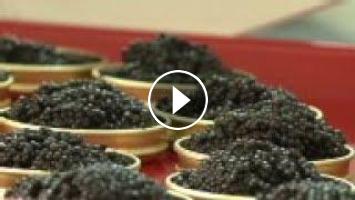
The eggs are then sorted into different sizes - the larger roe is considered more rare than the smaller varieties.
"On the left side you see what will be the 'Rare of Perlita'. It has 4 mm in diameter, in this one (ordinary one) that has 2.6mm (of diameter). That (Rare of Perlita) represents between one and three percent of our annual production," says Bouscaut.
Sturgeons are farmed for 7 to 10 years, before the females are slaughtered for their eggs.
L'Esturgeonniere harvests around 5,000 sturgeons per year which produces approximately three tons of caviar which is then sold worldwide.
Its market share represents around 10 percent of French production, according to Berthommier.
Find out more about AP Archive: http://www.aparchive.com/HowWeWork
Twitter: https://twitter.com/AP_Archive
Facebook: https://www.facebook.com/APArchives
Instagram: https://www.instagram.com/APNews/
You can license this story through AP Archive: http://www.aparchive.com/metadata/youtube/cb65d6a359204c669769ff683c5d7082
France is becoming a leader in the production of caviar as demand for the expensive delicacy continues to rise.
Three companies are now running aquaculture projects, turning out high quality fish eggs from Siberian sturgeons, grown in a controlled environment.
STORY-LINE :
It's often referred to as black gold - rare, exclusive and expensive.
Caviar is mostly known as a product from the Caspian Sea - with the most coveted eggs from the wild Beluga sturgeon, followed by Sevruga and Sterlet.
Traditionally, the main producers of caviar are from countries bordering the Caspian - Russia, Iran, Kazakhstan, Azerbaijan and Turkmenistan.
But as they grapple with problems linked to overfishing, other countries are now producing their own high quality products thanks to advances in aquaculture.
L'Esturgeonniere is one of three companies in the Aquitaine region in south western France that produces caviar.
It is one of the leaders of producing caviar in an aquaculture environment, using Siberian sturgeon, according to farm manager, Michel Berthommier
"The specificity of the French production (of caviar) is that it is about fish that was farmed since more than 30 years and that we were the first ones in France to make caviar of Siberian Sturgeon. That know how is historic and now, France is the country with the biggest history of caviar production in aquaculture," he says.
L'Esturgeonniere takes the water for its pools from the local river. The water is then heated to encourage spawning.
A lot of the knowledge the farmers gained was learnt on the job through trial and error.
"There was no school, we learned on the job. When I arrived here this was a farm that was producing only the sturgeon (not caviar); we had a problem with the market study regarding the price of the fish, so we said 'Sturgeon makes eggs, makes caviar, so let's make caviar.' So we were trying, tasting, we were testing until we defined our salting and our caviar," says caviar production manager, Marion Bouscaut.
Bouscaut says tests and improvements are made on a regular basis, especially getting the right flavour.
She says the right mix of salt with the roe is crucial as it can be the deciding factor between a good and bad caviar.
L'Esturgeonniere says it's found a way to turn its farmed Siberian sturgeon into a flavour that just about matches the most luxurious brands:
"It is the caviar that at the beginning, at the harvest has a rather light flavour - like butter, flour and sometimes like something greasy - and more caviar is matured, matured in its pot, flavours will be stronger. And after 8 to 10 months we will arrive to flavours that one can compare to those that the consumer of caviar from Caspian sea can think of," says Berthommier.
When the roe is removed from the sturgeon, it passes through a metal detector in case there are any small traces of metal that the fish has ingested.
The eggs are then sorted into different sizes - the larger roe is considered more rare than the smaller varieties.
"On the left side you see what will be the 'Rare of Perlita'. It has 4 mm in diameter, in this one (ordinary one) that has 2.6mm (of diameter). That (Rare of Perlita) represents between one and three percent of our annual production," says Bouscaut.
Sturgeons are farmed for 7 to 10 years, before the females are slaughtered for their eggs.
L'Esturgeonniere harvests around 5,000 sturgeons per year which produces approximately three tons of caviar which is then sold worldwide.
Its market share represents around 10 percent of French production, according to Berthommier.
Find out more about AP Archive: http://www.aparchive.com/HowWeWork
Twitter: https://twitter.com/AP_Archive
Facebook: https://www.facebook.com/APArchives
Instagram: https://www.instagram.com/APNews/
You can license this story through AP Archive: http://www.aparchive.com/metadata/youtube/cb65d6a359204c669769ff683c5d7082
- Category
- Tickling and Bondage
- Tags

Be the first to comment
Up Next
Autoplay
-
1:22:00

Bdsm. They Remembered The Caviar, But Not The Chains - Message by Dr. Chuck Baldwin on Aug. 9, 2020
-
02:25
Tickle Your Tastebuds | Spekboom
-
04:31
EMOTIONAL BONDAGE CHALLENGE Two French girls very funny FRENCH - ENGLISH LANGUAGE
-
1:26:08
Worldwide Prayer Meeting
-
01:04
Tickling French Girl 1 Teen Gay Feet Porn
-
01:38
Austin French | Tickling the Ivories
-
19:00
French mom immobilized full body tickling
-
07:28
Rare french tickling torture video
-
03:40
French Renefaire Tickling
-
12:16
French Tickling Lydia Latina Fetish
-
31:05

Let's play Trixie's Bad Bot Day: (Tickling RPG) - part 1
-
09:16

VERY HOT CHINESE GIRL Hogtied and Tickled with barefoot!!! Chinese Bondage/BDSM/tied up/hogtied
-
03:58

Escape Challenge || Jilbab Diikat (Req Subb)
-
14:26

Shibari You Can Use? Indo Girl Mummification, Breathplay (Bdsm)#5
-
30:03

Chinese Tickle in socks and barefeet
-
07:54

Kink Party Porn... Vanessa Julia 1
-
07:26

hijab girl mummyfied bondage
-
06:31

FENDOM FETISH. Ferry bound01
-
10:37

Girl tied gagged? ferry bound gagged
-
37:10

Indo Girl Mummified Egyptian Style.(Bdsm)#6 Megan Rain Bondage